

Farage brushes aside Reform controversies in closing conference speech
Farage's political controversy and confidence (A-level analysis)
The news article is primarily about Reform UK’s conference and party controversies, rather than a specific economic policy. Please remember, as A-level students we need to focus on economics so the article's direct economic impact is a bit limited.
The main economics link is political uncertainty. If controversy changes expectations about an election result or future policy, it could affect consumer and business confidence. Firms may delay investment if they are uncertain about future taxation, trade, regulation, immigration policy or government spending. Households may also postpone major purchases if they are less confident about future incomes, employment or taxes.
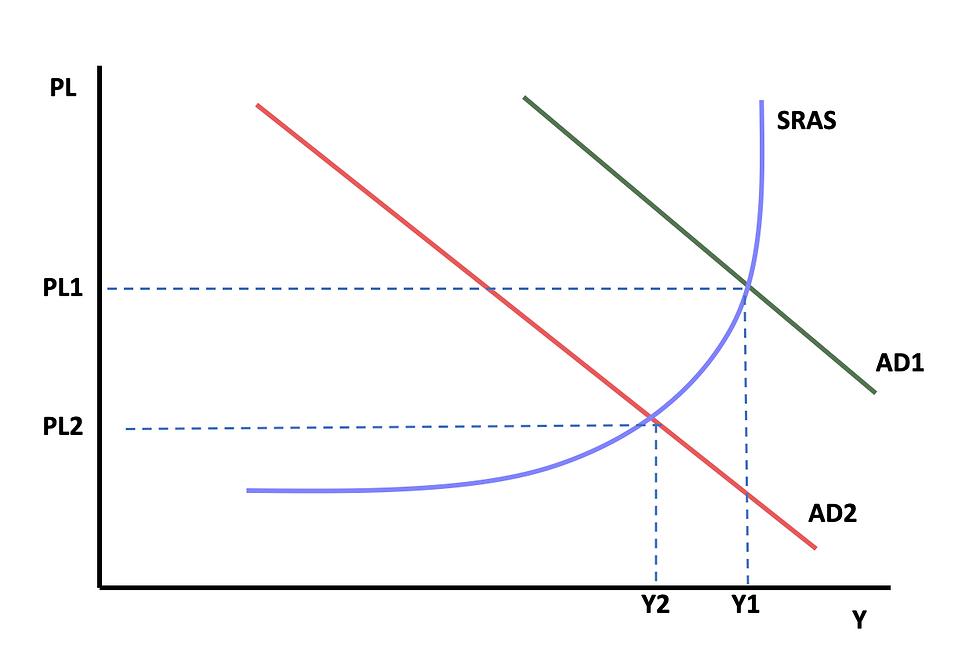
If uncertainty reduced consumption (C) and investment (I), aggregate demand could fall:
AD = C + I + G + (X − M)
This shifts AD from AD1 to AD2. In the short run, real GDP falls from Y1 to Y2 and the general price level falls from PL1 to PL2, or rises more slowly. Lower output could reduce firms’ demand for labour, causing cyclical unemployment.
However, this is only a possible outcome. The article does not show that consumer spending, investment, employment or financial markets have changed. A party conference or controversy is unlikely to have a large macroeconomic effect unless it causes a sustained change in voting intentions or expected government policy.
For firms, predictable policy is valuable because investment decisions are costly and long term. Greater uncertainty may slow investment and, over time, reduce productivity growth. Workers could be affected indirectly through weaker labour demand, fewer vacancies and slower wage growth.
The impact also depends on Reform UK’s political influence. If the party is unlikely to affect government policy, the economic effects are likely to be very small. Conversely, if political developments substantially change expected policies, confidence effects could become more significant.
Overall, the article has limited direct relevance to economics. Its strongest link is that political uncertainty may affect expectations, confidence, consumption and investment, but there is no evidence here of an immediate change in UK economic performance (again as Economics1.com students, you should always think about the impacts on the different economic stakeholders and weigh them up).


Comments