

PM Rejects Tax and Spend Approach
The article reports that Prime Minister Andy Burnham has rejected claims that his government is simply pursuing a “tax and spend” approach, while warning that the October Budget will involve “difficult decisions”. This follows UK CPI inflation rising from 2.9% in July to 3.1% in August 2026, partly because higher global energy prices have increased fuel and transport costs. At the same time, government borrowing costs have risen significantly, reducing the government's room for manoeuvre.
Households/consumers: Higher energy and fuel prices reduce households' real disposable income, particularly for lower-income households, who spend a greater proportion of their income on necessities. This reduces consumption (C) and therefore aggregate demand (AD). However, government support or higher welfare spending could protect living standards. The opportunity cost is that additional government spending may require higher taxation or borrowing.
Firms: Businesses face higher costs from energy, transport and potentially wages. This could shift SRAS left, causing cost-push inflation and lower real GDP:

Some firms may pass higher costs onto consumers, while others may experience lower profit margins and reduce investment or employment. However, a credible Budget could improve business confidence and encourage investment.
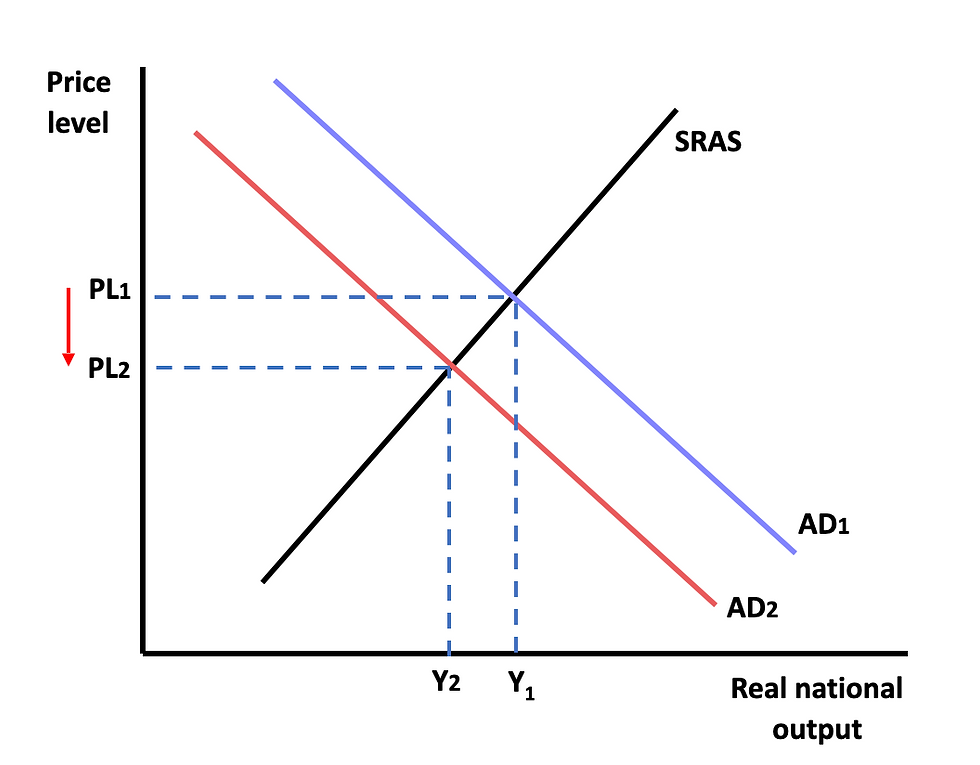
Government: The government faces a trade-off between economic growth, inflation, public services and fiscal sustainability. Higher taxes could reduce consumption and AD, while spending cuts could reduce AD and potentially worsen public-service provision. Conversely, reducing the budget deficit can improve confidence in government finances. The IFS highlights the existing pressure from high debt-interest costs and limited fiscal flexibility.
Workers: Inflation reduces the purchasing power of wages unless nominal wages rise faster than prices. Fiscal tightening could also reduce employment if lower government spending decreases AD. However, public-sector spending and investment can support employment and long-run productivity.
Financial markets/lenders: Higher government borrowing costs increase the cost of servicing national debt, creating an opportunity cost because more tax revenue may have to be devoted to debt interest rather than public services or investment. Maintaining investor confidence is therefore important.
Bank of England: Persistent inflation may create pressure for higher interest rates. Higher rates could reduce consumption and investment, shifting AD left, helping to control inflation but potentially reducing economic growth and increasing mortgage costs.
Conclusion
You as Economics1.com students should have learnt..... that almost every news story can be analysed using the concepts of scarcity, opportunity cost, incentives, stakeholders, AD/AS, inflation, unemployment, economic growth, fiscal policy and monetary policy. The key economic problem in this article is the trade-off between supporting households and economic growth while maintaining price stability and sustainable public finances. There is no single policy without costs: the impact depends on the size of the multiplier, the state of the economy, the distribution of costs and benefits, and the time period considered.


Comments